Introduction
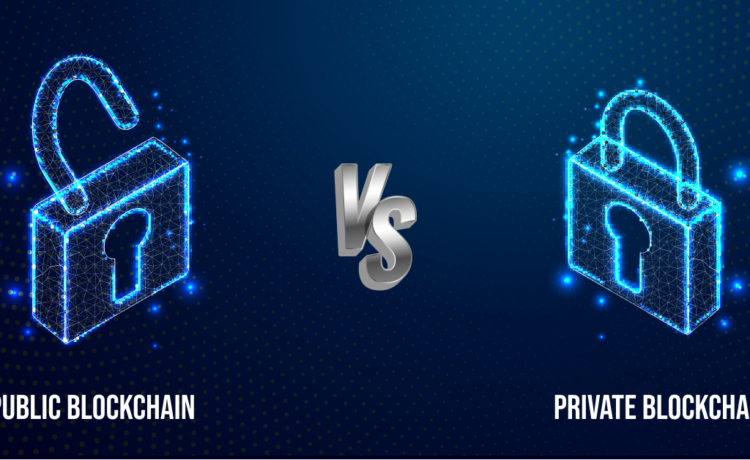
Blockchain technology is not a one-size-fits-all solution. While many people associate it with cryptocurrencies, there are different types of blockchain networks designed for distinct purposes. The two primary categories are public blockchains and private blockchains.
Understanding the differences between them is essential for businesses, developers, and investors evaluating blockchain-based solutions.
What Is a Public Blockchain?
A public blockchain is an open, permissionless network that anyone can join and participate in. No central authority controls access.
Key characteristics include:
- Open participation: Anyone can read, write, or validate transactions.
- Decentralization: Control is distributed across thousands of nodes.
- Transparency: Transaction data is publicly visible.
- Strong security: Consensus mechanisms secure the network.
Examples of public blockchain features:
- Cryptocurrencies operating without central banks
- Global peer-to-peer transactions
- Open-source development
Public blockchains prioritize trust minimization and censorship resistance.
Advantages of Public Blockchains
Public networks offer several benefits:
- High transparency and auditability
- Resistance to single-point failure
- Strong network security through decentralization
- Global accessibility
Because no single entity controls the ledger, users do not need to trust a central authority.
However, openness can come at the cost of performance and privacy.
Limitations of Public Blockchains
Despite their strengths, public blockchains have constraints:
- Slower transaction speeds compared to centralized systems
- Higher energy consumption in some consensus models
- Public visibility of transaction data
- Governance complexity
Scalability remains a key challenge for many public networks.
What Is a Private Blockchain?
A private blockchain is a permissioned network controlled by a single organization or a consortium of entities. Access is restricted to approved participants.
Core characteristics include:
- Controlled access: Participation requires authorization.
- Faster performance: Fewer nodes often result in quicker validation.
- Enhanced privacy: Data visibility is limited to participants.
- Centralized governance: Clear decision-making structure.
Private blockchains are typically used by enterprises seeking operational efficiency while maintaining control.
Advantages of Private Blockchains
Private networks offer practical benefits for businesses:
- Greater transaction speed
- Lower operational costs
- Customizable governance models
- Improved data confidentiality
Because the network is permissioned, organizations can tailor it to specific industry needs.
Limitations of Private Blockchains
Private blockchains trade decentralization for efficiency.
Common drawbacks include:
- Reduced transparency
- Higher reliance on trust among participants
- Potential vulnerability to centralized manipulation
- Limited censorship resistance
In essence, private blockchains are closer to shared databases with cryptographic enhancements.
Public vs. Private: Key Differences
The core differences between public and private blockchains can be summarized as follows:
Access
- Public: Open to anyone
- Private: Restricted to approved users
Control
- Public: Decentralized governance
- Private: Centralized or consortium governance
Transparency
- Public: Fully transparent ledger
- Private: Controlled data visibility
Speed
- Public: Generally slower due to large network size
- Private: Faster due to fewer validators
Use Cases
- Public: Cryptocurrencies, decentralized applications, open ecosystems
- Private: Enterprise supply chains, financial settlement systems, internal record management
Each model serves a different purpose depending on business goals and trust requirements.
Hybrid and Consortium Models
Between fully public and fully private systems lies a middle ground: hybrid or consortium blockchains.
In these models:
- Multiple organizations jointly manage the network
- Access may be partially restricted
- Governance is shared
Consortium blockchains are common in banking, trade finance, and supply chain ecosystems where collaboration is necessary.
This blended approach balances decentralization and operational efficiency.
Choosing the Right Blockchain Type
Selecting between public and private blockchain depends on specific objectives.
Consider the following questions:
- Is transparency essential or optional?
- Are participants known and trusted?
- What level of regulatory compliance is required?
- Is speed or decentralization more important?
For open financial ecosystems, public blockchains are often suitable. For internal enterprise operations, private networks may offer better performance and control.
Security Considerations
Security models differ significantly.
Public blockchains rely on economic incentives and distributed consensus to secure the network. The larger the network, the harder it is to compromise.
Private blockchains depend on controlled access and governance policies. While efficient, they may be more vulnerable to insider threats.
Security effectiveness depends on implementation and oversight rather than blockchain type alone.
The Bigger Picture
Public and private blockchains are not competitors. They address different needs.
Public networks prioritize openness and decentralization. Private networks emphasize control and efficiency.
As blockchain adoption expands, organizations increasingly adopt hybrid strategies that combine elements of both systems.
Understanding the differences enables better decision-making in a rapidly evolving technological landscape.
Frequently Asked Questions (FAQ)
1. Can a private blockchain become public later?
Yes, though transitioning requires structural and governance changes to open network participation.
2. Are private blockchains more secure than public ones?
Not necessarily. Public blockchains rely on decentralization for security, while private networks depend on internal controls.
3. Do public blockchains guarantee anonymity?
They provide pseudonymity, not complete anonymity. Transaction data is publicly visible.
4. Which type is better for enterprises?
Private or consortium blockchains are often preferred due to performance and regulatory considerations.
5. Are transaction fees lower on private blockchains?
Typically yes, since fewer validators and consensus mechanisms reduce operational costs.
6. Can smart contracts run on both public and private blockchains?
Yes. Smart contracts can operate on either type, depending on platform capabilities.
7. Is decentralization always necessary?
Not always. Decentralization is valuable when trust minimization is critical, but centralized solutions may suffice in controlled environments.